Utility vs marketing WhatsApp templates: which to use and when
The exact difference between utility and marketing WhatsApp templates, Meta's current rates, and how to pick the category in ten seconds.
 008 teamNovember 5, 20264 min read
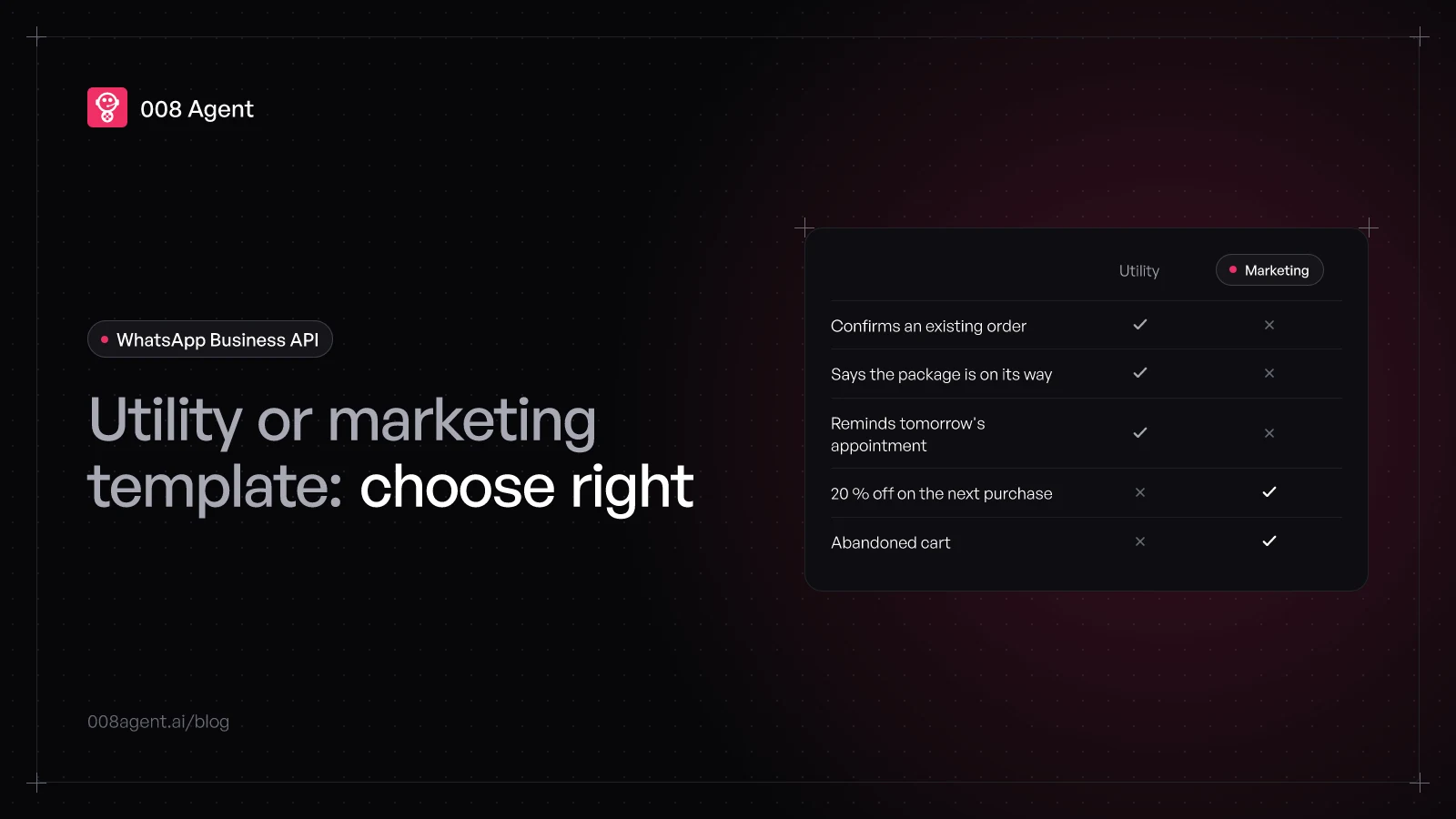
Every template you send through the WhatsApp API falls into a category, and that category decides two things: whether Meta approves it and how much you pay. Mixing utility with marketing is the most expensive (and most common) template mistake: the same message can cost 4.7 times more depending on the box you tick.
This guide covers the exact difference, current pricing, and how to pick the category in ten seconds without depending on Meta's judgment.
The difference in one sentence
A utility template reports on something the customer already did or already expects: their order, their delivery, their appointment, their payment. A marketing template pushes for a new action: an offer, a launch, a repurchase. Meta's own category docs say it: utility covers what's «specific to or requested by a user»; marketing covers what «drives awareness or sales».
And there's a nuance that catches everyone: the final category isn't your choice. You tick a box when creating the template, but Meta re-evaluates the message's real intent and wording. Write «order» but add a discount, and it gets reclassified or rejected.
| Utility | Marketing | |
|---|---|---|
| Confirms an existing order | ||
| Says the package is on its way | ||
| Reminds tomorrow's appointment | ||
| 20 % off on the next purchase | ||
| Abandoned cart |
Price is not a detail
Since July 2025 Meta charges per delivered message, not per conversation, and the rate depends on category and recipient country. In Mexico, with the rate card in force since October 1, 2026: marketing costs 0.0397 USD per delivered message and utility 0.0085 USD. Those are Meta's rates, before tax and before your provider's margin.
At those numbers, a 10,000-message marketing campaign pays about 4.7 times more than the same 10,000 utility templates: roughly 397 USD versus 85 USD. Choosing the category well isn't bureaucracy; it's the difference between a flat bill and one with surprises.
October 1, 2026 brought two more changes worth knowing: utility templates sent inside the 24-hour window are no longer free, and service messages (free-form replies) are charged past a 1,000-per-month allowance per number. The free 72-hour window from click-to-WhatsApp ads stays.
The trap: mixing both worlds in one template
The classic case: "Your order #2451 is on its way. Enjoy 20 % off your next purchase with code NEXT20". It looks helpful, but it carries a commercial incentive: Meta classifies it as marketing and you pay full rate for a message that was 90 % informational. And if Meta reclassifies it without telling you, the overcharge lands straight on your bill.
The working rule: one template, one purpose. Pure utility stays with facts: "Your order #2451 has left the warehouse. Track your delivery here". The promotion travels alone, in its own marketing template, to whoever it belongs. More writing work, much lower bill.
Windows: when you can reply for free
When a customer messages you, a 24-hour service window opens and renews with each of their messages. Inside that window you can reply free-form, no template: it's the cheapest way to serve, and with an AI agent replying in real time you use the whole window. Templates exist for the opposite case: writing first, when the window is closed.
How to decide the category in ten seconds
Does the message exist because of a customer action (bought, booked, paid)? Utility.
Does it exist because your campaign calendar says so? Marketing.
Does it carry a commercial incentive, discount or call to buy? Marketing, always, even if it mentions an order.
Does it mention "your abandoned cart"? Marketing: Meta treats it as commercial reactivation, not a transaction.
Hesitating between two? Split it into two templates. The hybrid always ends up paying the marketing rate.
What an AI agent has to do with this
Categories punish improvisation and reward conversation. An AI agent on WhatsApp replies in the moment, inside the window, without burning templates: every question, order change or reschedule resolves in free text. Templates remain for the proactive part: confirming, notifying, reminding. In how to send bulk messages without getting blocked we cover the campaign side, and in recovering abandoned carts over WhatsApp the reactivation playbook.
For agents that serve inside the window and use the right category when writing first, create a free account or book a demo.
Frequently asked questions
Can I send a utility template to someone who never bought?
No. Utility requires an underlying transaction or request: an order, an appointment, a payment. Without one, the message is marketing, and Meta classifies it that way no matter how informational the wording looks.
Can Meta change the category after approving it?
Yes. Meta approves, rejects or reclassifies based on intent and wording, and it can change the category without notice. Before each send, check the template's final category in your dashboard.
Do template variables change the category?
No. Variables work the same in both categories. What decides is the intent of the text around them: facts and data are utility; incentives and promises are marketing.
Can the abandoned-cart reminder be utility?
No. Even if it says "your order", its job is reactivating a purchase that didn't happen: it's marketing, and budgeting it as utility is how bills surprise you.
How much does separating categories well save?
It depends on the country. In Mexico, with Meta's rates from October 2026, a correctly classified message pays 0.0085 USD instead of 0.0397 USD: 4.7 times less per delivered message.
You might also like
Prompt injection: a security guide for chatbots
What prompt injection is, the real cases that cost money ($1 Tahoe, Air Canada) and the four defense layers OWASP recommends for your chatbot.
Bulk WhatsApp messages without getting blocked
How to send bulk WhatsApp messages without getting your number blocked: opt-in, approved templates, growing limits and the quality signals Meta watches.
AI agent: what it is, its components and how it differs from a bot
What an AI agent is, the components it's built from (brain, memory, tools) and how it differs from a bot or a decision tree, with real examples.
Put an agent to the test.
Request a demo or talk to our agent on WhatsApp right now.