AI agent: what it is, its components and how it differs from a bot
What an AI agent is, the components it's built from (brain, memory, tools) and how it differs from a bot or a decision tree, with real examples.
 008 teamOctober 27, 20265 min read
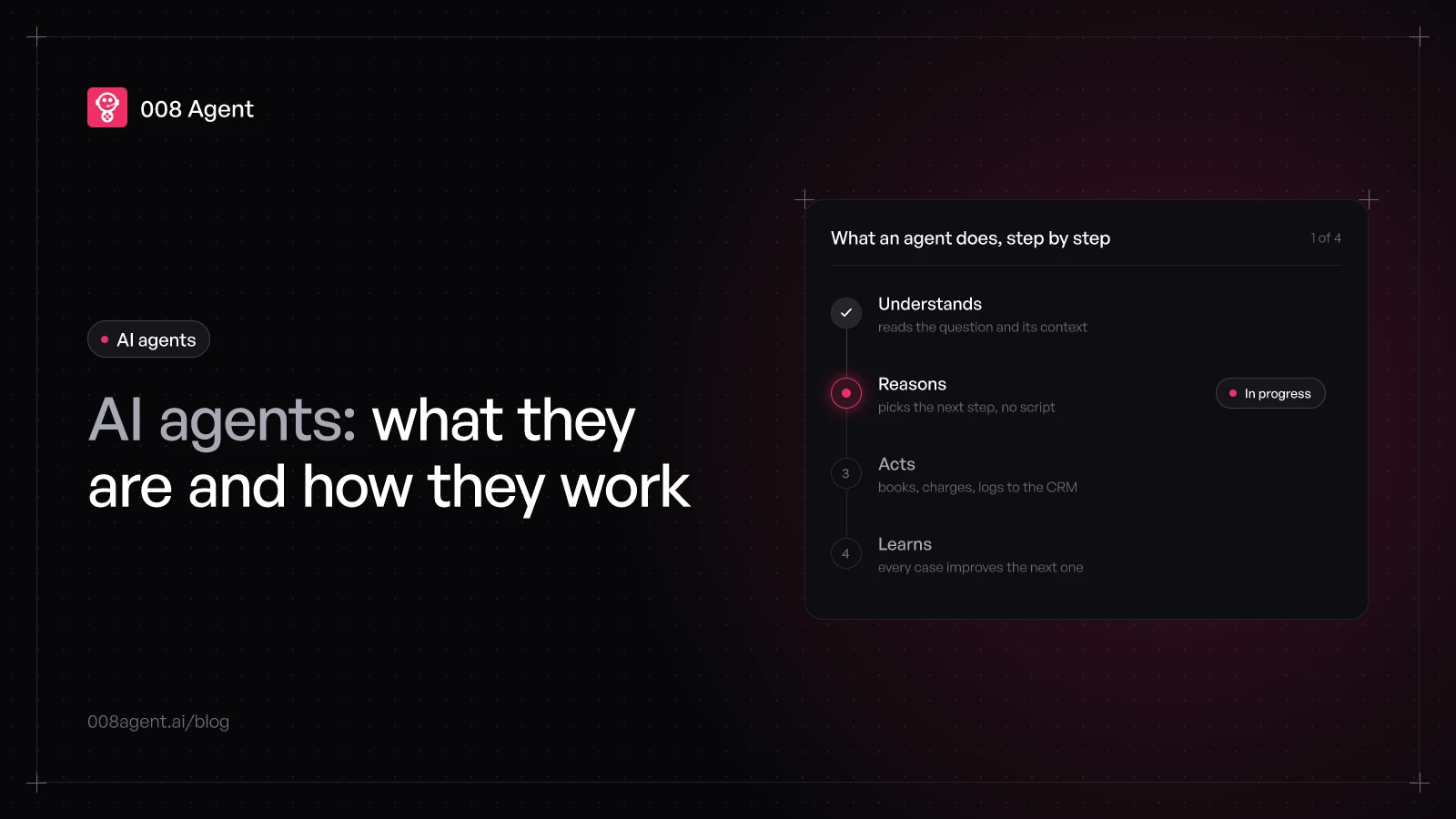
An AI agent is a program that understands what you ask, decides how to solve it, and executes the steps to get it done. No script, no decision tree, no human plotting every move.
This isn't lab luxury. Gartner estimates that by 2028 one third of enterprise software will include agentic AI, up from less than 1% in 2024. And 62% of organizations are already experimenting with agents, according to McKinsey's State of AI 2025. The question isn't whether it reaches your industry, but when and how prepared you'll be.
What is an AI agent
The definition fits in one line: a system that pursues a goal on its own, choosing its steps based on what it finds. It rests on three pillars:
It understands. It processes natural language: what the customer types or says, mistakes, detours and context included.
It reasons. It picks the next step for the situation, not from a fixed map. If the plan changes, it adapts.
It acts. It doesn't stop at the reply: it checks the CRM, books the appointment, sends the payment link, logs the outcome.
That third pillar is what separates an agent from a chatbot. A bot talks to you; an agent gets it done.
What components an AI agent has
Under the hood, almost every agent running in production combines the same six pieces:
The brain is a language model: it interprets the request and decides what to do. Memory keeps history and context, so nobody gets asked twice. Tools are the actions it can execute: logging to the CRM, checking an order, taking payment. The channel is where it lives: WhatsApp, the phone, the web. Guardrails are the limits: what it may do alone and when it must hand off to a person. And metrics close the loop: every interaction gets recorded, transcribed and measured.
Remove one piece and it stops being an agent. Without tools it's a chat with good rhetoric; without guardrails it's a liability; without metrics, a black box.
AI agent, bot and decision tree: the real differences
Three terms that marketing loves to blur. Let's untangle them.
A decision tree is a fixed map of options: if the customer says A they get 1; if they say B they get 2. It works for closed procedures and fails the moment someone leaves the path. A classic chatbot is, most of the time, a tree dressed as a chat: it recognizes keywords and jumps between nodes, but neither understands nor acts. Our WhatsApp chatbot vs AI agent comparison walks through it case by case.
An AI agent has no map: it has a goal and tools. If Marta writes «can I get my order on Friday instead of Thursday?», the tree has no branch for that; the agent checks the order, verifies shipping, moves the date and confirms. What would be twenty nodes in a tree is one more decision for the agent.
| Decision tree | AI agent | |
|---|---|---|
| Follows a fixed script | ||
| Gets stuck off-script | ||
| Checks your systems (CRM, calendar) | ||
| Handles the task end to end | ||
| Improves with every conversation |
How it works, step by step
An agent's cycle fits in four moves:
Understand. Read the question and its context: who's asking, what happened before, what they own.
Reason. Pick the next step with no script: if a detail is missing, ask; if everything's there, execute.
Act. Book, charge, log to the CRM, change the delivery. And confirm what was done.
Learn. Every case leaves a record: what worked, what escalated, what resolved on its own.
And back to the start. The difference with classic automation is that nobody programmed each fork: the agent composes the route on the fly.
What companies use agents for
The best-return use cases share a pattern: high volume, repetitive task, clear criteria. A few examples:
Sales. Qualify leads coming from ads, answer objections, book demos or visits. The human team receives an advanced conversation, not a cold lead.
Support. Resolve the recurring questions (order status, invoices, hours) and escalate the rest with context.
Collections. Remind due dates, offer payment links, log promises. Empathy at ten at night, every night.
Appointments. Book, confirm and remind; reschedule on its own when the customer can't make it.
If your channel is the phone, we reviewed the best voice AI agents on the market; and to build the WhatsApp operation, the WhatsApp Business agents guide.
How to start without dying in the attempt
The classic mistake is automating the whole department in month one. The short path:
Pick one bounded case, with a clear start and end (appointments, order status, first contact in sales).
Define what the agent does alone and what escalates to a person. Guardrails are designed before, not after.
Measure from day one: conversations resolved, time per task, sales booked.
With 008 Agent you deploy voice and WhatsApp agents with the language model included: voice starts at $0.03 per minute and you build no infrastructure. You can create a free account or book a demo and see an agent working your case within a week.
Frequently asked questions
Is ChatGPT an AI agent?
Not exactly. ChatGPT is a conversational model: it understands and generates text. It becomes an agent when you connect tools and memory so it can execute tasks: search, book, send. The model is the brain; the agent is the whole system.
How is it different from a copilot?
A copilot suggests: it drafts the answer and waits for a human to send it. An agent executes: it closes the task end to end and leaves a record. The copilot speeds your team up; the agent multiplies its capacity.
Does an AI agent replace people?
It takes the repetitive part and escalates the rest. Well configured, it routes to a person exactly when needed: a complaint, a complex doubt, an angry customer. The team stops answering the same thing a hundred times and focuses on what matters.
How much does it cost to run an AI agent?
It depends on channel and volume. A voice agent on 008 Agent starts at $0.03 per minute with voice and model included; on WhatsApp you pay per conversation. Pricing is public so you can run the numbers before talking to anyone.
Want to see the difference on your own case? Try an agent for free or book a demo with your scenario. From question to completed action: that's an AI agent.
You might also like
Best voice AI agents in 2026: an honest comparison
We reviewed the voice AI agent platforms that actually take calls in 2026 — from 008 Agent and ElevenLabs to Vapi, Bland, Synthflow, Infobip, Wati, Gupshup and Botmaker — plus which popular tools are text-only.
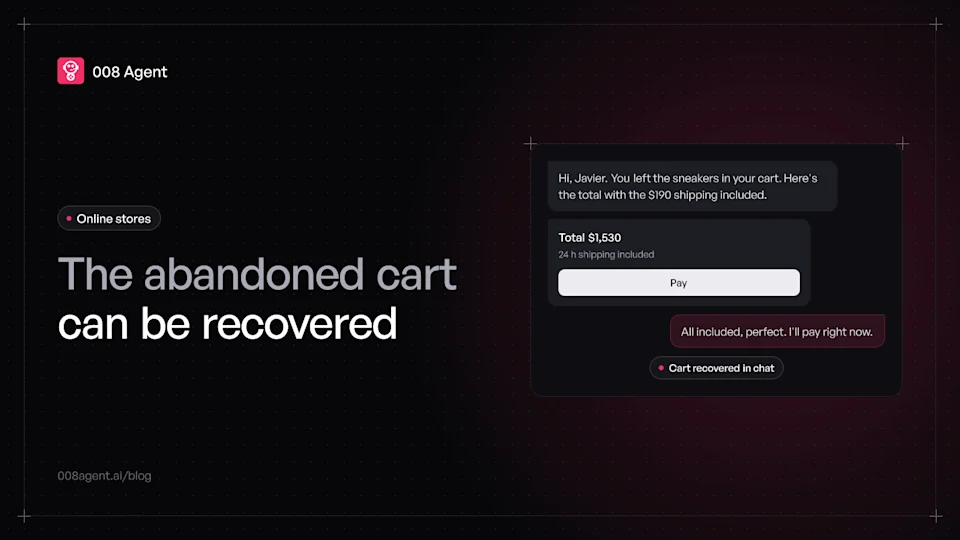
How to recover an abandoned cart with WhatsApp
70 % of carts never convert. The causes, the WhatsApp recovery sequence, and the mistakes that get your number flagged.
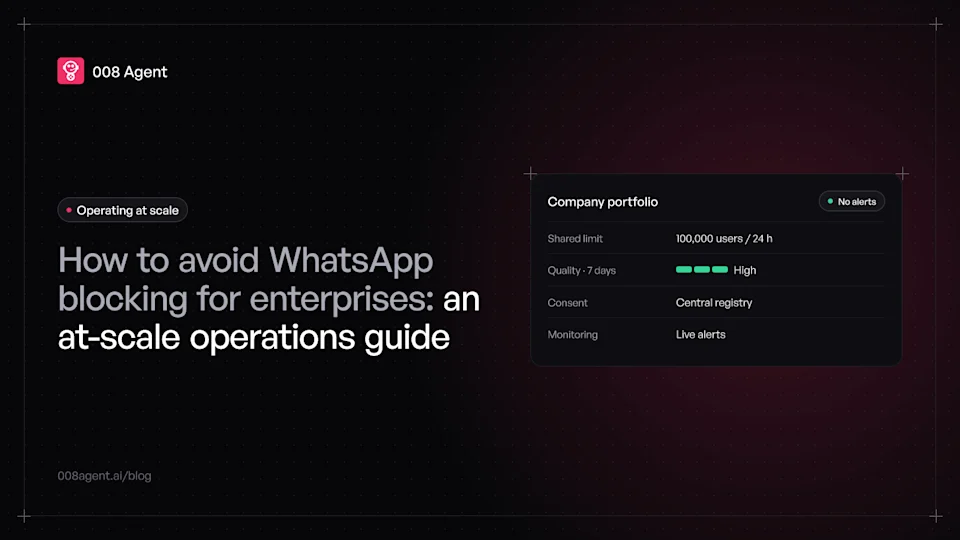
How to avoid WhatsApp blocking for enterprises: an at-scale operations guide
A guide for large companies: how WhatsApp portfolio limits and quality rating work at scale, and the sending governance your team needs to keep the number alive.
Put an agent to the test.
Request a demo or talk to our agent on WhatsApp right now.