

WhatsApp Per-Message Pricing: Your Guide to October 1, 2026
September 15, 2026
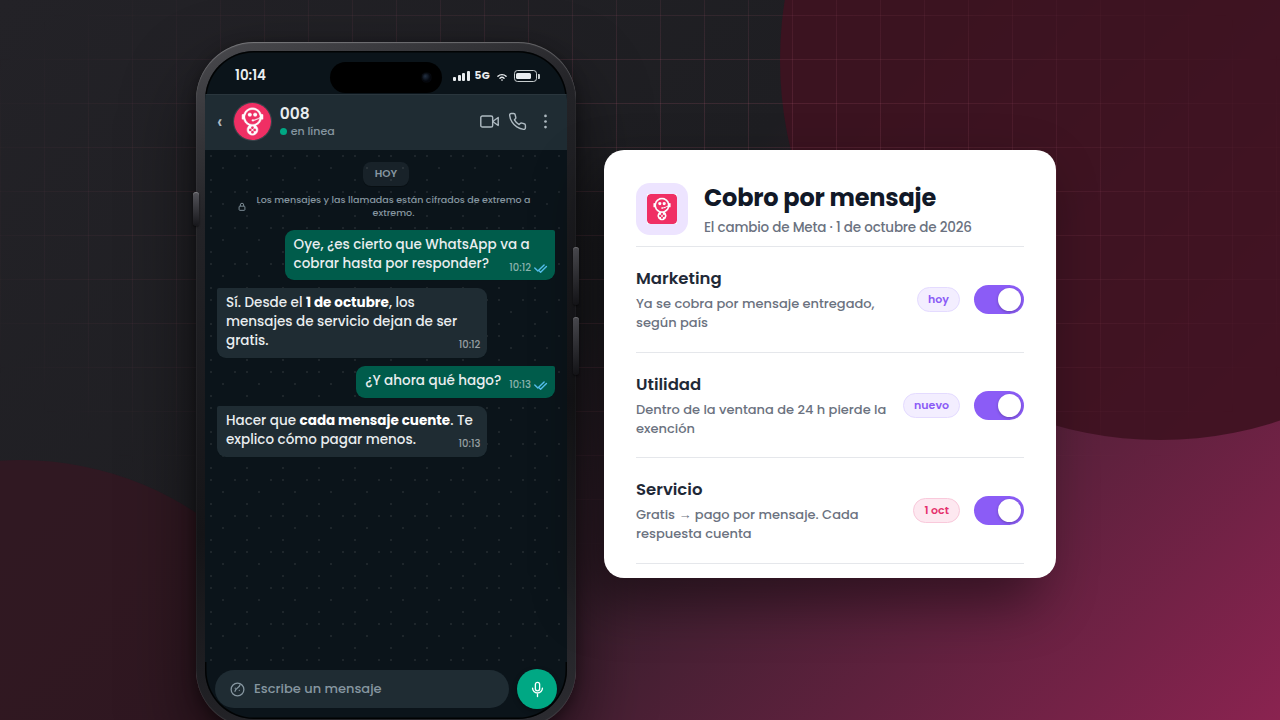
On October 1, 2026, WhatsApp Business loses its last free ride. That day, service messages —the ones you send to reply to a customer inside the 24-hour window— stop being free and are charged per delivered message. If your operation lives on chat, the math changes: every reply counts.
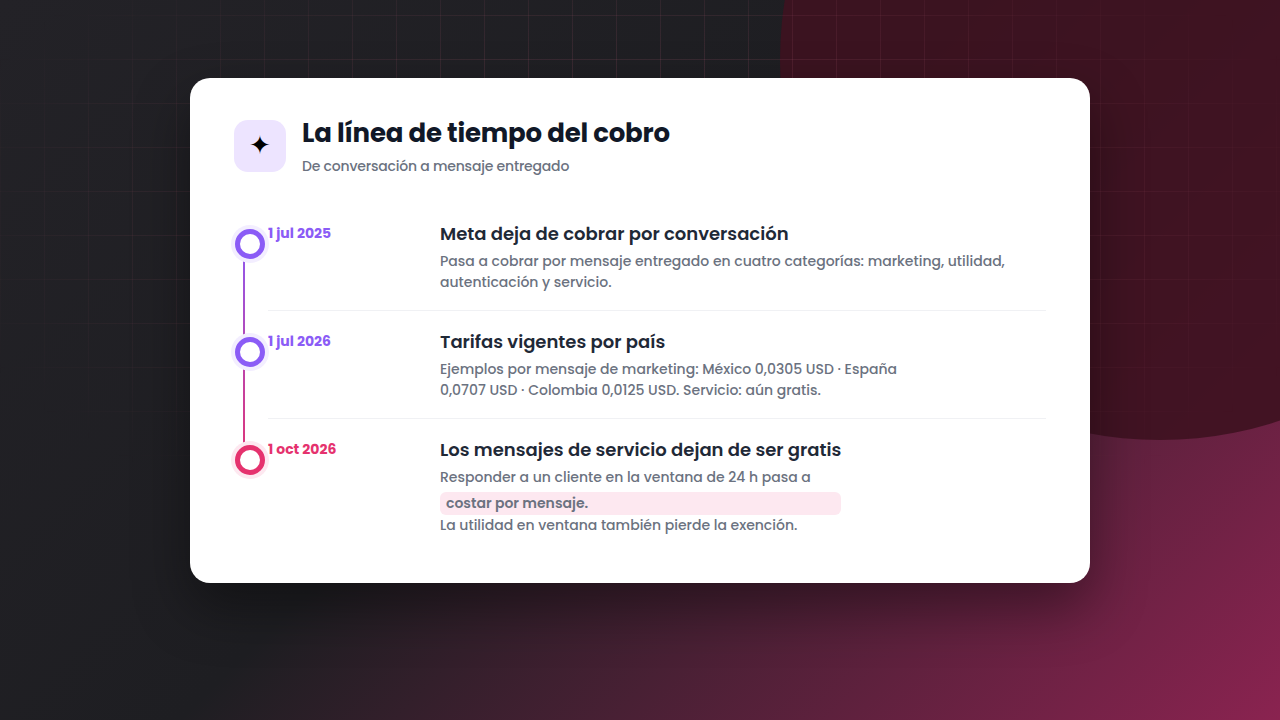
This is not a surprise move. It is the third step on a path Meta announced well in advance. First it stopped charging per conversation (July 2025). Then it adjusted rates by country (July 2026). Now it closes the service exemption. The good news: there is room to prepare — and even come out ahead, if you start replying better than before.
This guide explains exactly what changes, what a message costs today, and how to soften the impact on your bill. If you are not on the WhatsApp Business API yet, you can create your 008 Engage account and follow along with your real operation.
From conversations to delivered messages
Until July 2025, WhatsApp Business charged per conversation: you opened a 24-hour window and replied as much as you wanted inside it. Meta replaced that model with per-delivered-message pricing across four categories: marketing, utility, authentication and service. The price depends on the recipient's country, not the sender's.
Service stayed exempt: replying to a customer who wrote first was still free. That exemption is exactly what disappears on October 1, 2026.
What a WhatsApp message costs today
These are the current rates per delivered message in two key markets, according to the official WhatsApp Business Platform pricing table (July 2026):
Country | Marketing | Utility | Authentication |
Spain | 0.0707 USD | 0.0200 USD | 0.0200 USD |
Mexico | 0.0305 USD | 0.0085 USD | 0.0085 USD |
Across the rest of the region, a marketing message runs about 0.0125 USD in Colombia, 0.0618 USD in Argentina and 0.0889 USD in Chile. High volume tiers can lower the utility and authentication rates, and Meta only bills messages that are delivered. For service starting in October, the published reference for Mexico points to a price similar to utility: 0.0085 USD per message.
It looks tiny. Multiply it by thousands of conversations a month and by the habit of replying in three- or four-message bursts. That is where the decimals start to hurt.
An example with numbers
Picture a dental clinic in Mexico City handling 3,000 WhatsApp conversations a month. Each conversation averages six service messages: greeting, question, answer, confirmation, reminder, goodbye. That is 18,000 messages that cost zero today.
From October 1, with Mexico's published reference of 0.0085 USD per service message, the same operation pays about 153 USD a month. Without changing anything. Without new campaigns. Just for existing.
Now apply debounce: if half the conversations involve burst-writing customers and the agent consolidates its replies, you save two messages per conversation. That is 6,000 fewer messages: 51 USD a month back in your pocket. And a single well-written reply usually converts better than five short ones.
What exactly changes on October 1
Service messages stop being free: replying inside the 24-hour window is charged per delivered message.
In-window utility loses its exemption: confirmations and notices you sent for free are billed like everything else.
The free 72-hour window only survives from free entry points (Instagram or Facebook CTAs, click-to-WhatsApp ads).
Undelivered messages are not billed: charging happens on delivery, same as the current model.
How to cut the bill without answering less
The change punishes operations that reply badly: message bursts, reminders to people who already answered, duplicate templates blasted to the whole base. And it rewards the ones that reply well. 008 Engage is the AI agent platform for WhatsApp and the rest of the Meta ecosystem, built so that every message counts:
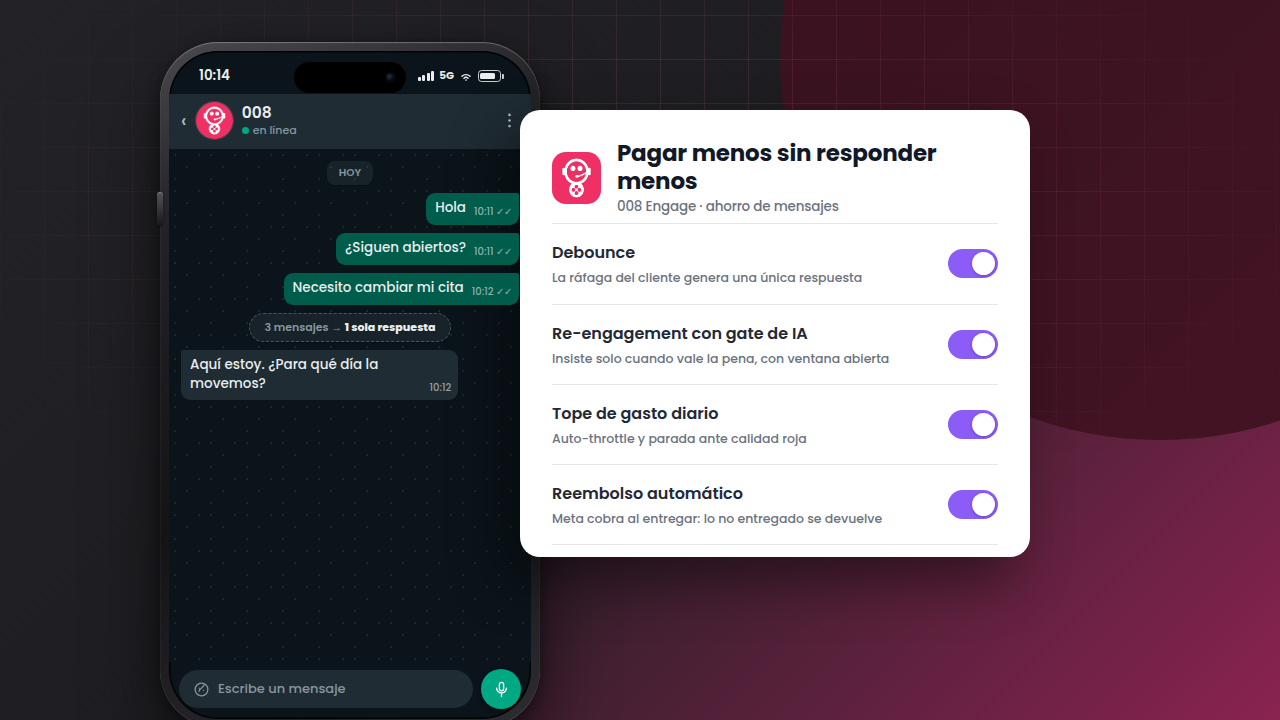
Debounce. When a customer sends five messages in a row, the agent waits and replies once. Four fewer messages per conversation, every single time it happens.
AI-gated re-engagement. The agent follows up only when the lead deserves it and only while the window is open. It never burns messages for nothing.
Behavior branches. The second template of a campaign goes only to those who did not answer the first. Responders get no noise and generate no cost.
Automatic refunds. Meta charges on delivery. Undelivered messages are automatically refunded after the deadline.
Daily spend cap, auto-throttle and preflight. Set a budget ceiling, campaigns brake themselves if lead quality drops to red, and preflight audits spend before you launch.
Engage's pricing model is pay-per-use with no fixed fee: check the conditions on the pricing page. And if you are still unsure whether you need a classic chatbot or an AI agent, our chatbot vs AI agent comparison settles it in five minutes.
Checklist before October 1
Calculate your exposure: last month's service messages × your country's rate = new baseline cost.
Audit the utility templates you sent free inside the window; they now add up too.
Consolidate replies: a customer burst should produce one answer, not five.
Cut blind re-engagement; follow up only where the data justifies the message.
Set a daily spend cap and run preflight before every mass campaign.
Review which free entry points (Instagram or Facebook CTAs) you can activate to earn the 72-hour window.
October 1 is weeks away. Teams that prepare now will pay fair; teams that ignore it will find out on the invoice. If you want to see your operation running with AI agents on WhatsApp, book a demo and we will look at your numbers together.
Written by

008 Agent
The best AI Agent
Tags
AI Agents
¡Suscríbete a nuestra NL!
By submitting, you agree to receive emails from 008. Check our privacy policy for details. Read policies.


