

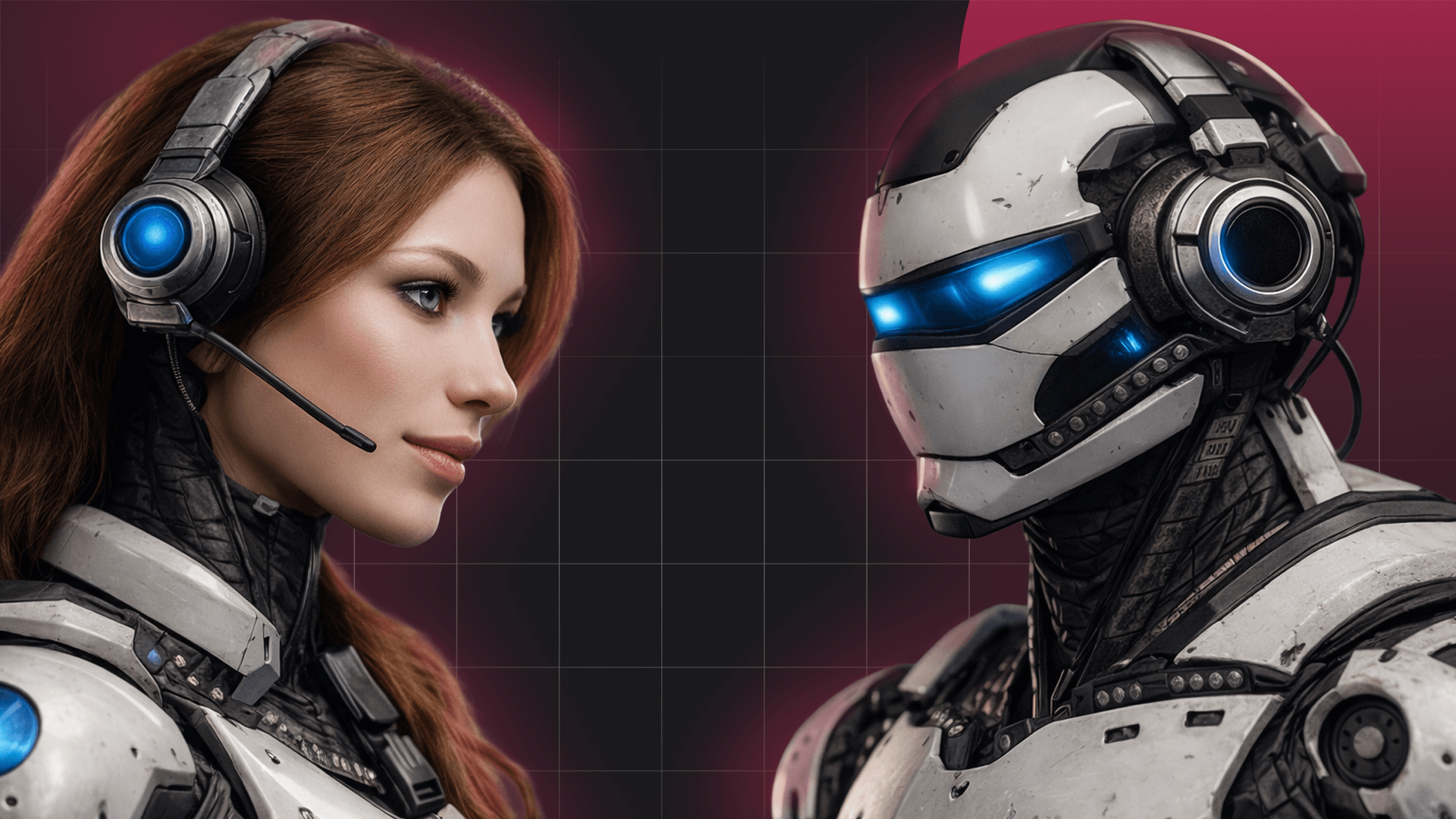
Voicebot vs AI Voice Agent: Key Differences Explained
December 16, 2025
Voice automation has become a key pillar in customer service, sales and operations. However, not all “AI voice solutions” are created equal.
Two terms are often confused: voicebots and AI agents. While they may sound similar, they represent very different levels of intelligence, flexibility and business impact.
Let’s break down the differences.
What Is a Voicebot?
A voicebot is an automated voice system built around predefined scripts and decision trees.
It can recognize speech and map it to expected intents, but it operates within strict, preconfigured flows.
Voicebot Characteristics
Script-based logic
Linear conversation paths
Limited intent recognition
No real understanding of context
Breaks easily when users deviate from expected answers
Common Voicebot Use Cases
IVR menus
Call routing
FAQ automation
Simple status checks
Voicebots are efficient for highly predictable interactions, but they struggle in real conversations.
What Is an AI Agent?
An AI agent is a conversational system powered by advanced language models that can understand intent, maintain context and adapt dynamically during a conversation.
Unlike voicebots, AI agents are designed to reason, decide and act, not just follow scripts.
AI Agent Capabilities (General)
Natural language understanding
Context awareness
Flexible dialogue handling
Ability to execute actions
Better error handling and recovery
AI agents aim to replicate how humans communicate, rather than forcing users into rigid flows.
Key Differences: Voicebots vs AI Agents
Area | Voicebots | AI Agents |
Conversation flow | Fixed | Dynamic |
Context handling | Minimal | Advanced |
Flexibility | Low | High |
Error recovery | Poor | Strong |
User experience | Robotic | Natural |
Complexity handled | Simple | Moderate to high |
Why Voicebots Often Fail in Real Calls
Voice calls are messy by nature:
People interrupt
Change their mind
Use different wording
Expect immediate understanding
Voicebots are not designed for this reality. They assume perfect user behavior, which rarely happens.
AI agents, on the other hand, are built to handle ambiguity, making them far better suited for real-world conversations.
Where 008 Agent Comes In
While AI agents exist in many forms, 008 Agent focuses specifically on voice-native AI agents for telephony environments.
This is where our approach differs.
How 008 Agent Implements Voice AI Agents
Native SIP Extension (PBX-First Approach)
With 008 Agent, AI voice agents register as a standard SIP extension inside your PBX — just like a human agent.
This means:
No special call flows
No external voice layers
Full compatibility with any PBX
From the telephony system’s perspective, the AI agent is just another extension.
Real Speech-to-Speech Conversations
008 Agent uses a speech-to-speech model, enabling:
Ultra-fast responses
No awkward pauses
Natural conversation rhythm
This avoids the latency issues typical of traditional voice automation systems.
Transparent, Predictable Pricing
Most AI solutions charge by tokens, requests or hidden usage metrics.
008 Agent keeps it simple:
From €0.18 per minute
No token-based billing
No hidden fees
Clear, predictable costs
Unlimited Tools During Calls
Our AI agents can use unlimited tools while speaking with callers, enabling real actions, not just conversations.
There are no artificial limits on integrations or workflows.
Web-Based Deployment
Deployment and configuration are handled via a web-based interface, making rollout and scaling fast and controlled.
Final Thoughts
Voicebots were the first step in voice automation. AI agents are the next evolution.
But how those AI agents are implemented makes all the difference.
By being:
Voice-native
SIP-based
Speech-to-speech
Transparently priced
008 Agent delivers AI voice agents built for real phone calls — not demos.
Written by
008 Agent
The best AI Agent
Tags
008
¡Suscríbete a nuestra NL!
By submitting, you agree to receive emails from 008. Check our privacy policy for details. Read policies.


